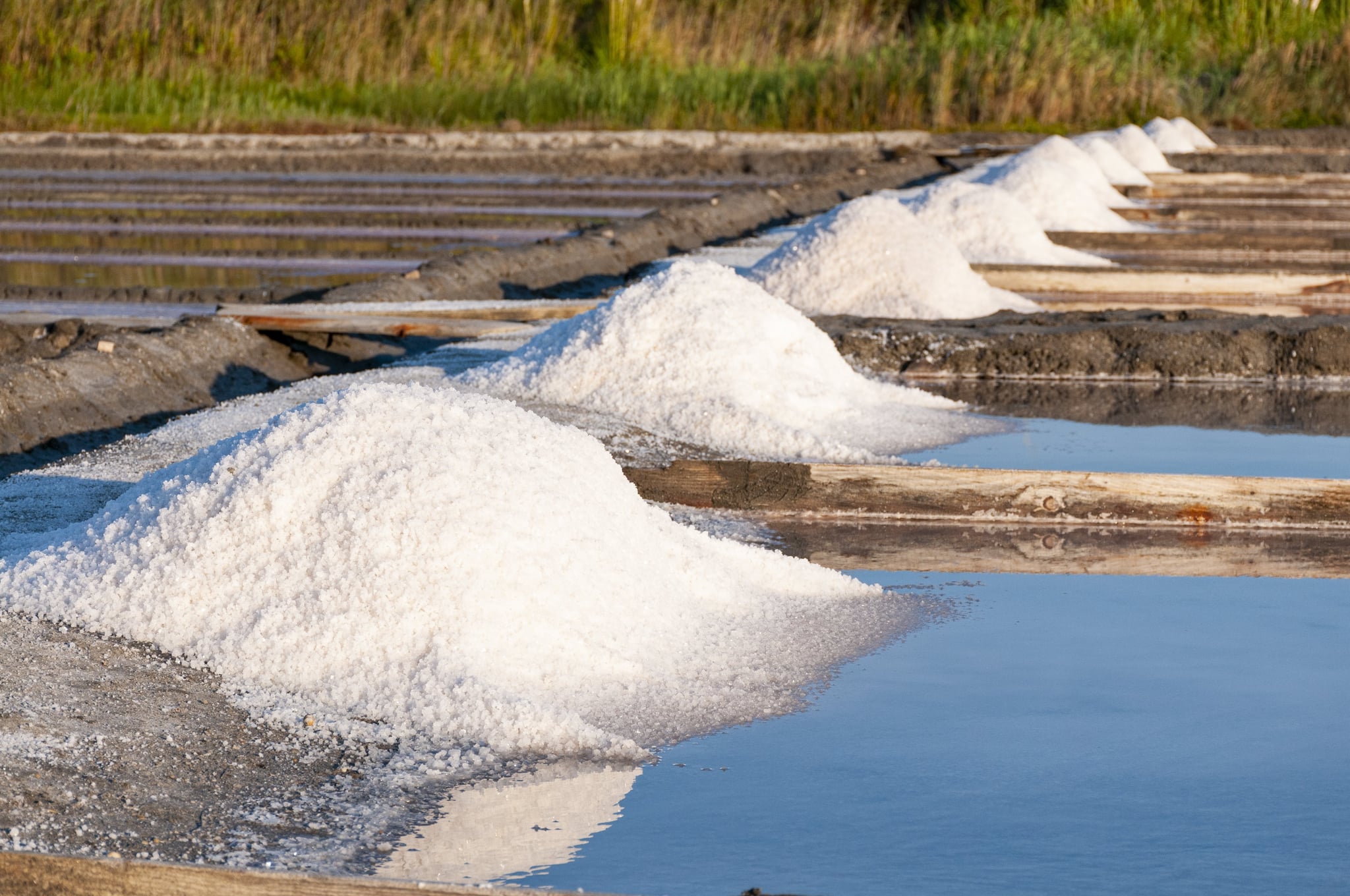
Mention Aveiro and most people picture the moliceiros. The ovos-moles. Those striped houses in Costa Nova. But the landscape that truly shapes the lagoon, the one that gave it its history, is something else entirely: the salt pans.
A legacy that runs deep
Salt production in the Aveiro lagoon has more than a thousand years of documented history, with references appearing in royal charters as early as the 10th century. For centuries, salt from these waters cured Portuguese cod, sailed north to the quays of Flanders, and propped up entire economies built on a product as simple as it was essential.
At its peak, the lagoon held more than 270 working salt pans. Today, only a handful remain. Some survive out of sheer stubbornness, others through reinvention as cultural or touristic sites. Very few on profitability alone.
How a salt pan actually works
The system is elegantly simple. Seawater flows in from the lagoon and moves through a sequence of interconnected basins, each with its own role. First the reservoirs, then the settling tanks, then the intermediate pools, until the water finally reaches the crystallisation beds, where evaporation does the rest.
All of this is managed by the marnoto, a figure who is part farmer, part hydraulic engineer, part craftsman. The classic tool of the trade is the rodo. A wooden implement with a short name and a precise gesture, passed down from father to son across generations.
Fleur de sel, that fine layer forming on the surface during warm summer afternoons, is still harvested by hand. The marnotos will tell you that you can hear when it's ready. A light crackle, when the salt has reached its moment.
More than a product
The salt pans are also an ecosystem. Flamingos, black-winged stilts, herons, avocets. The list of birds nesting in or passing through the lagoon is a quiet delight for any patient observer. The salinity balance created by the pans sustains a biodiversity that would vanish if the basins were abandoned.
Which is why talking about salt pans today inevitably means talking about conservation. Keeping a pan active costs money, demands skilled labour, and depends on weather patterns that grow less predictable every year. Marinha da Troncalhada, converted into an open-air ecomuseum, shows how living heritage can coexist with public outreach. Salina de Santiago da Fonte, among others, still produces fleur de sel on a small scale for a market that has learned to value provenance.
Come slowly
If you come, come slowly. Salt pans don't reveal themselves from a car window, nor in half an hour. Walk the paths between the basins, or cycle them. Preferably in the late afternoon, when low light turns the water into a mirror.
Several pans offer guided tours, hands-on harvesting experiences for anyone willing to pull on a pair of boots, and the occasional shop where you can buy salt directly from the producer. None of this is spectacular in the Instagrammable sense. It's a different kind of thing.
It's a way of looking at time, at the sea, and at a craft that, against the odds, still insists on carrying on.